Harbinger Days
Spring is coming. My confidence grows because the chorus frogs and the peepers say so, and they always know.
Dr. Bruce Smith ——Bio and Archives--March 18, 2025
HeartlandLifestyles | CFP Comments | Reader Friendly | Subscribe | Email Us
It always sneaks up on me. I become so accustomed to winter’s bluster that I no longer notice that I’m leaning into every day’s chill and every morning’s frost. Of course there’s the scarf and the heavy coat each morning. There are two pairs of gloves in the pockets. I go out the door squinting, hunched over, trying not to feel the cold.
The last deep freezing spell was pretty recent, so it must be coming back. Better bundle up in anticipation. Sure enough, the frost lingers still on the windshield and on the unheated roof. Zip the coat tight against the neck, and hurry!
We get warm spells, then a return to temperatures in the teens, then a drop only to the twenties, but the Brrrr! factor lingers.
The first surprise came last Wednesday. A red winged blackbird, male, flashed across my path on a back country road. I had the windows up so there was no comforting trill sound to accompany. Ooh! He must be early. Still, nice to see, and it’s been a while. I slide back into my heated driving.
The next day, Thursday, I saw a grackle with his characteristic boat tail glide across another road before landing on a fence post. Interesting! Grackles go south somewhere because I never see them over the winter. This one had the strange gold eyes and shimmering blue-brown feathers that look oiled.
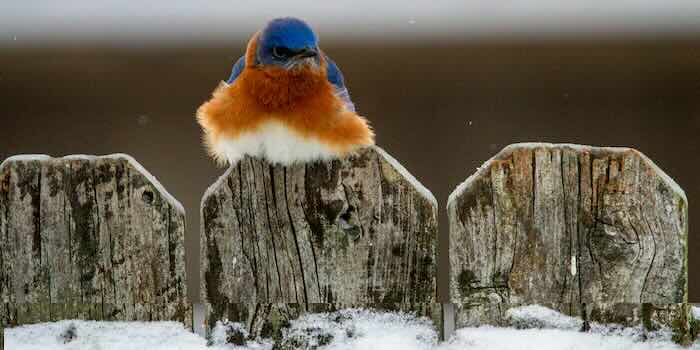
On Saturday I gave a fruit tree pruning workshop out at a country place set back off a quiet road. That afternoon bluebirds showed up with their pleasant and sweetly plaintive chirrup. The owner’s bluebird house had long ago lost its floor and rested on the orchard floor. Better get that put back together. The bluebird scouts are looking for a rental! Put up two or three bluebird houses around a big orchard and they’ll soon be filled with broods served by diligent bluebird parents.
Then Monday the big surprise caught me when I wasn’t expecting it. I was driving home from another orchard along a twisty, ill-maintained country road. Suddenly I landed on an elevated bridge with a steel grid floor that roared a growl at me as I went over it too fast. Wasn’t expecting that. I watched the curving road ahead without noticing the green tips emerging from a marsh. It was warm, in the 60s, so I had left the truck window down without thinking about it. A hundred or more yards beyond the bridge the sound of high pitched croaking flooded into the window. Oh! Chorus frogs! I could picture them just out of the water on cattail shoots or dry stems, but couldn’t see them. They’re small and they blend well, but they were making their calls in competition with each other. Probably males showing off. Go figure. But chorus frogs are a sure sign of spring. I smiled to myself as I drove on.
Now I figure that one patch of marsh with standing water hosting chorus frogs is a fine thing, but when spring really arrives, there will be many patches of these, audible from quite a distance. Sometimes the swamps are out of sight, only the steady calling of the amphibians. So after my surprise, I drove on, hoping for the other signs in the next couple of weeks.
It wasn’t half a mile further when I came to another little sheltered bottom below the eroded landscape in this unglaciated part of Indiana. With the window still down the noise hit me suddenly as if they had paused, waiting until I was at the closest point to the wet area before calling out. This time it was spring peepers, unmistakable with their high-pitched peeping. Chorus frogs make a kind of ‘brit-brit’ croak while peepers sound almost like a whistle. On the same day, close together, I had heard both of the true harbingers of spring.
Fruit tree buds have not moved much yet, although the apricots are off to a too-early start as usual. They will bloom gloriously as they always do, then a freeze will kill the apricot crop for another year. Red maples are blooming while Canada geese, snow geese, and Sandhill cranes call overhead. Saucy squirrels stare at the bird feeders from the edge of the woods, and pileated woodpeckers rat-tat, rat-tat-tat on dead stubs high in the trees, or on stumps next to the ground, leaving their debris of wood chunks to remind us of their visits.
I reason with the apricots, urging them to slumber just another couple of weeks, but they won’t listen, or they listen but they don’t heed my cautions.
I returned home with a little glow in my heart for the peepers and the chorus frogs who serenaded me that day. It’s time for some spring after a winter of more normal cold in several spells.
At the last moment I think of the slate-colored juncos, the snow birds as we call them. They arrived last October ahead of time because they knew the winter would be harsher than usual. As I look out the window to the feeders I don’t see any of them mixed with the finches and the cardinals. Come to think of it, I don’t remember when I saw the last one. The snowbirds have left without ceremony or good-byes to head back to their summer homes in the True North. I miss them already. They will be welcomed far above the 45th Parallel with the lengthening days as we welcome them when winter approaches.
Spring is coming. My confidence grows because the chorus frogs and the peepers say so, and they always know.
View Comments
Dr. Bruce Smith (Inkwell, Hearth and Plow) is a retired professor of history and a lifelong observer of politics and world events. He holds degrees from Indiana University and the University of Notre Dame. In addition to writing, he works as a caretaker and handyman. His non-fiction book The War Comes to Plum Street, about daily life in the 1930s and during World War II, may be ordered from Indiana University Press.
Support Canada Free Press